
 Алгебра
 Английский
 Биология
 География
 Геометрия
 История
 Русский
 Обществознание
 Физика
 Химия
Химия Информатика
 Литература
 Математика
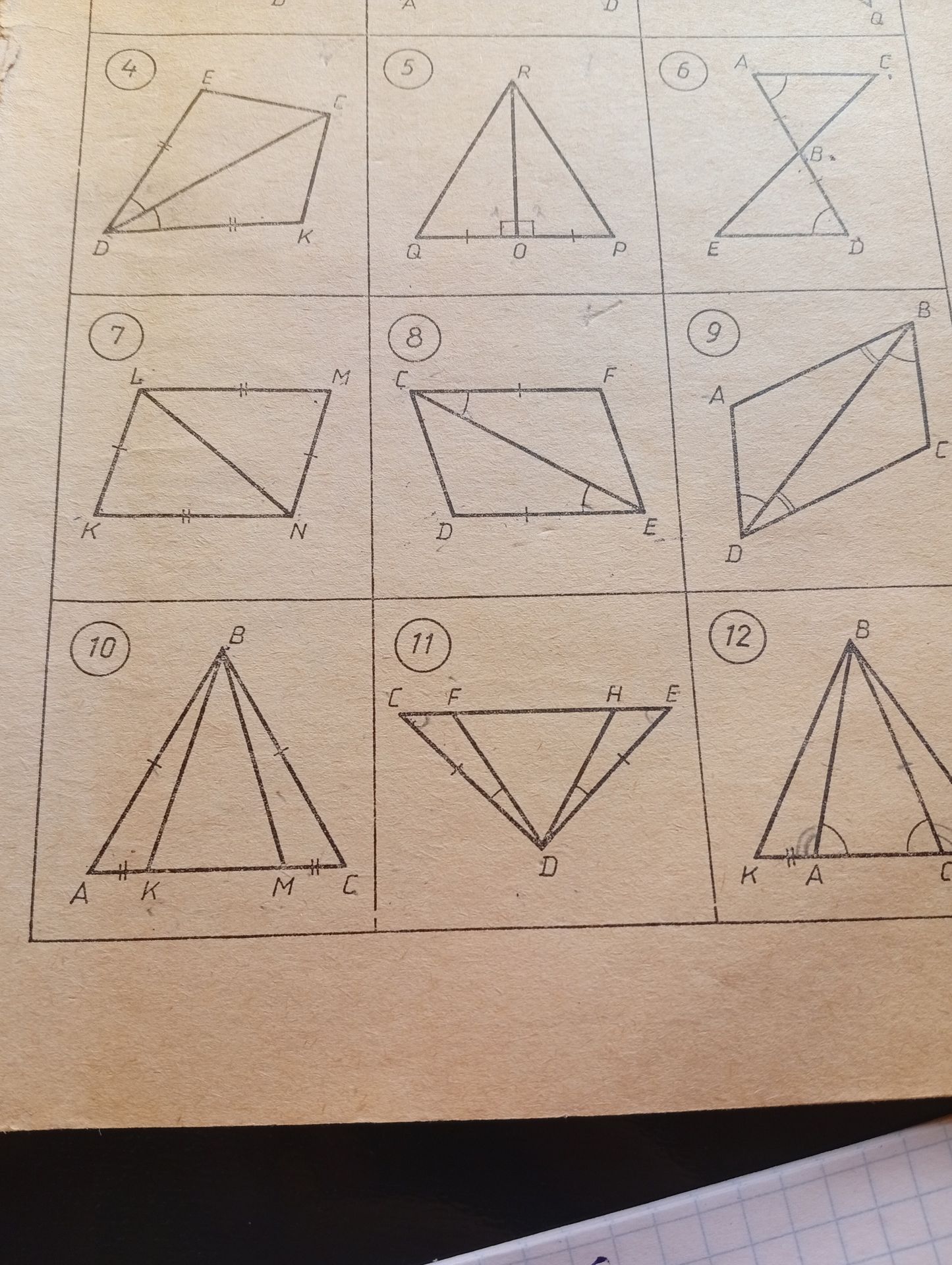
Figure 9. Given quadrilateral ABCD, with AB || DC and AD || BC. Also, ∠ADC = ∠BCD. Prove that ABCD is a square.
Ответ:
Proof:
We are given a quadrilateral ABCD with the following properties:
- AB || DC (Opposite sides are parallel)
- AD || BC (Opposite sides are parallel)
- ∠ADC = ∠BCD (Given)
From properties 1 and 2, we know that ABCD is a parallelogram because both pairs of opposite sides are parallel.
Now let's use the properties of a parallelogram and the given angle equality:
- Opposite sides of a parallelogram are equal: AD = BC and AB = DC.
- Opposite angles of a parallelogram are equal: ∠ADC = ∠ABC and ∠DAB = ∠DCB.
- We are given that ∠ADC = ∠BCD.
- Since ABCD is a parallelogram, opposite angles are equal. Therefore, ∠ADC = ∠ABC and ∠BCD = ∠DAB.
- From property 3, we have ∠ADC = ∠BCD.
- Combining this with property 2 (∠ADC = ∠ABC and ∠BCD = ∠DAB), we get:
- ∠ADC = ∠ABC = ∠BCD = ∠DAB.
- ABCD is a parallelogram (from AB || DC and AD || BC).
- In a parallelogram, opposite angles are equal (∠ADC = ∠ABC, ∠DAB = ∠BCD).
- Adjacent angles are supplementary (∠ADC + ∠BCD = 180°).
- We are given ∠ADC = ∠BCD.
- ABCD is a parallelogram (given AB || DC and AD || BC).
- Opposite sides are equal: AB = DC and AD = BC.
- Given ∠ADC = ∠BCD. Since adjacent angles in a parallelogram sum to 180°, ∠ADC + ∠BCD = 180°. Substituting gives 2∠ADC = 180°, so ∠ADC = 90°. Similarly, ∠BCD = 90°. Since opposite angles are equal, ∠DAB = ∠ABC = 90°. Thus ABCD is a rectangle.
- Assumption/Missing Information: Let's assume AD = DC.
- Since AD = DC, and from property 2, AB = DC and AD = BC, we have AB = BC = CD = DA.
- A rectangle with all sides equal is a square.
This means all four angles of the parallelogram are equal.
Since the sum of angles in a quadrilateral is 360°, and all four angles are equal, each angle is \( \frac{360°}{4} = 90° \).
So, ABCD has four right angles, which means it is a rectangle.
Now we need to check if all sides are equal to prove it is a square. We know that AB = DC and AD = BC (from property 1).
We are given ∠ADC = ∠BCD. This, along with the fact that ABCD is a parallelogram, implies all angles are 90°. However, this alone does not guarantee equal sides.
Let's reconsider the given information. We have a parallelogram ABCD, and ∠ADC = ∠BCD.
If ∠ADC = ∠BCD, and we know that adjacent angles in a parallelogram are supplementary, then ∠ADC + ∠BCD = 180° only if AD || BC. This is already given.
Let's look at the angles again. We have a parallelogram ABCD. Opposite angles are equal: ∠ADC = ∠ABC and ∠DAB = ∠DCB. Adjacent angles are supplementary: ∠ADC + ∠DCB = 180°, ∠DCB + ∠CBA = 180°, etc.
We are given ∠ADC = ∠BCD.
Since ABCD is a parallelogram, opposite angles are equal, so ∠ADC = ∠ABC and ∠BCD = ∠DAB.
If ∠ADC = ∠BCD, then all four angles are equal: ∠ADC = ∠ABC = ∠BCD = ∠DAB.
As calculated before, this implies each angle is 90°, so ABCD is a rectangle.
Now, let's think about the sides. We know AB || DC and AD || BC. This makes it a parallelogram.
The condition ∠ADC = ∠BCD is a consequence of it being a parallelogram, unless it implies something more.
Let's re-examine the figure. The figure shows that AD is not equal to DC. There are no tick marks to suggest equal sides.
If the problem statement intended to provide enough information to prove it's a square, there might be missing information or a misunderstanding of the diagram.
Let's assume the problem meant that ∠ADC = ∠DAB (adjacent angles are equal), which would imply 90°. Or that AD = DC.
If we assume the figure implies that AD = DC, then since ABCD is a parallelogram, it would be a rhombus. A rhombus with one right angle is a square. If ∠ADC = 90°, then ABCD is a square.
However, based strictly on the given text:
Substituting (4) into (3): ∠ADC + ∠ADC = 180° => 2∠ADC = 180° => ∠ADC = 90°.
Since ∠ADC = 90°, and opposite angles are equal, ∠ABC = 90°. Also, ∠BCD = ∠DAB = 90°.
So, ABCD is a rectangle (a parallelogram with four right angles).
To be a square, all sides must be equal (AB = BC = CD = DA).
The given information AB || DC, AD || BC, and ∠ADC = ∠BCD only proves that ABCD is a rectangle. It does not inherently prove that AB = AD or DC = BC.
The figure itself does not show equal sides.
Therefore, based solely on the provided text, ABCD can only be proven to be a rectangle, not necessarily a square.
If the intention was for ABCD to be a square, then either AD = DC must be given, or ∠ADC = ∠DAB must be given (which would lead to 90° angles and then using the parallelogram property of equal opposite sides would not be sufficient, we would need an adjacent side equality).
Revisiting the problem: If we assume the figure's proportions are somewhat accurate, it doesn't look like a square.
Let's assume there's a missing condition, such as AD = DC, or an angle like ∠DAB = 90°.
Conclusion based on provided text only: ABCD is a rectangle.
If the problem explicitly asks to prove it's a square, and the provided text is all we have, then the statement cannot be proven as stated without additional assumptions or information.
However, in a typical geometry problem context, if it asks to prove something, it should be provable from the given information. Let's consider if there's a deduction missed.
Parallelogram + ∠ADC = ∠BCD. This implies ∠ADC = 90° and ∠BCD = 90°. Also ∠DAB = 90° and ∠ABC = 90°. So it's a rectangle.
For it to be a square, we need adjacent sides to be equal. Example: If AD = DC.
If AD = DC, then since it's a parallelogram, AB = DC and BC = AD. So AB = BC = CD = DA. Thus, it's a rhombus. A rhombus with a right angle is a square.
Let's assume the question implies AD = DC due to the symmetry of ∠ADC = ∠BCD being equal and adjacent, or it's an intended missing piece of information to make it a square.
Let's try to prove it's a square by assuming AD = DC is implied or missing:
Conclusion (if AD = DC is assumed): ABCD is a square.
Conclusion based strictly on given text (without assuming AD=DC): ABCD is a rectangle.
Given the phrasing
Похожие
- Figure 4. The given figure shows a quadrilateral DECK, where DE = EK and ∠EDC = ∠KDC. Prove that △DEC is an isosceles triangle.
- Figure 5. Given △ROP, RO = OP, and RO ⊥ OP. What is the measure of ∠ORP?
- Figure 6. Given △ABC and △EDB, ∠BAC = ∠BED, AB = ED, and AC = EB. Prove that △ABC ≅ △EDB.
- Figure 7. Given parallelogram LMCF, with LM = MF and ∠MLF = 90°. Prove that LMCF is a square.
- Figure 8. Given △CDF, CD = CF, and ∠CDF = ∠CFD. Point E is on CD and point F is on DF. Line segment CE is drawn. If △CDE ≅ △CFE, prove that △CDF is an isosceles triangle.
