
 Алгебра
 Английский
 Биология
 География
 Геометрия
 История
 Русский
 Обществознание
 Физика
 Химия
Химия Информатика
 Литература
 Математика
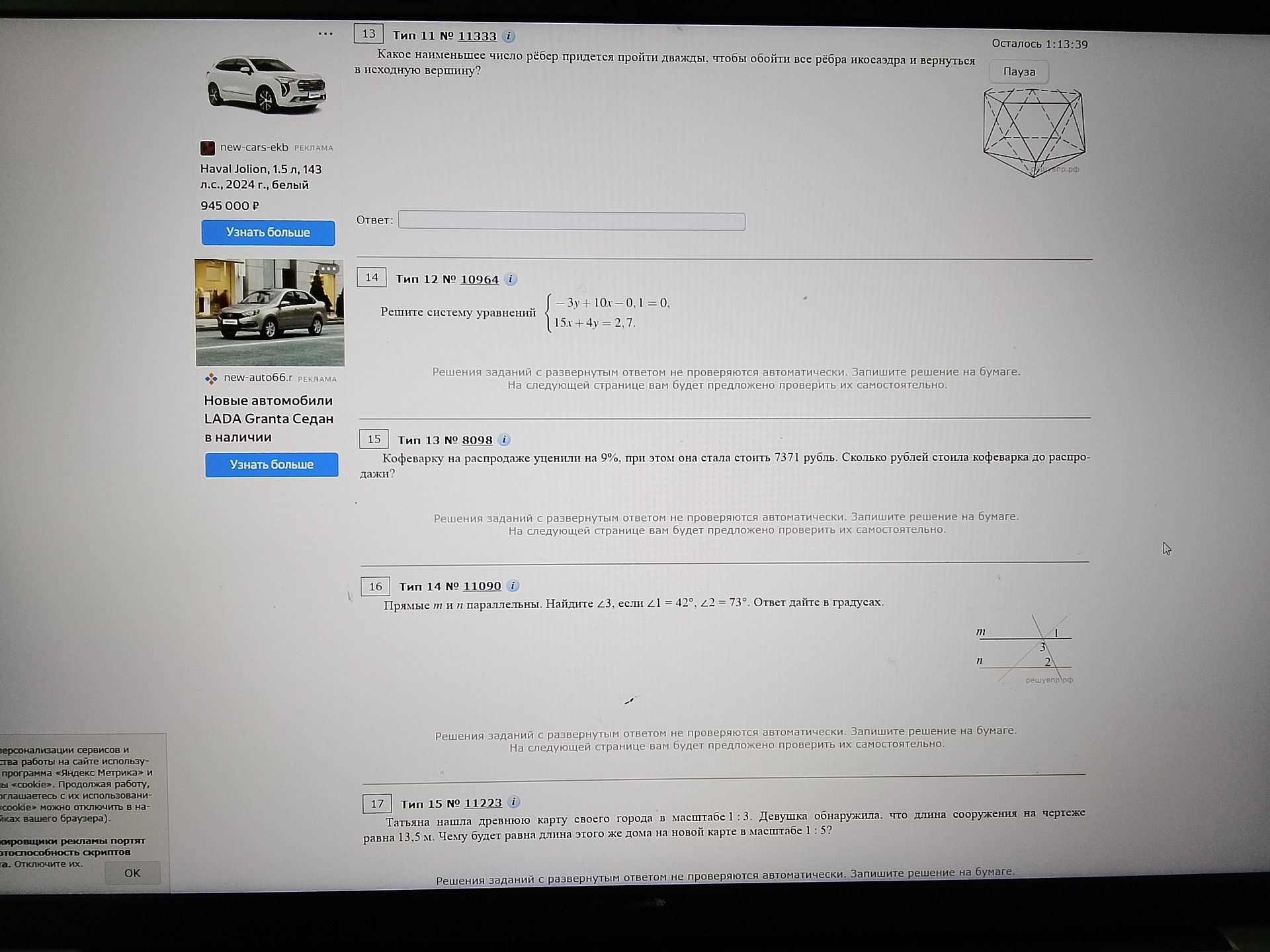
Прямые m и n параллельны. Найдите ∠3, если ∠1 = 42°, ∠2 = 73°. Ответ дайте в градусах.
Ответ:
Решение:
Дано: прямые \(m\) и \(n\) параллельны, \(\angle 1 = 42^\circ\), \(\angle 2 = 73^\circ\).
Найти: \(\angle 3\).
\(\begin{asy}\)
size(100);
real angle1=42;
real angle2=73;
real angle3;
draw((0,0)--(4,0));
draw((0,1.5)--(4,1.5));
label("$$m$$", (4,1.5), E);
label("$$n$$", (4,0), E);
draw((1,1.5)--(2,0));
label("$$1$$", (1.3,1.3));
label("$$3$$", (1.8,0.5));
label("$$2$$", (2.3,0.3));
// draw arcs for angles 1 and 2 (for illustration, not part of calculation)
// draw(arc((1.1,1.5),0.2,0,angle1));
// draw(arc((2.3,0.2),0.2,180,180-angle2));
// Calculate angle3 based on geometry
// Angle 1 and the angle adjacent to 3 are corresponding angles, so they are equal.
// Let's call the angle adjacent to 3 and 1 as angle 4. angle4 = 42 deg.
// Angle 3 and angle 4 are supplementary (form a straight line), so angle3 + angle4 = 180 deg.
// However, the diagram suggests angle 1 is alternate interior angle to an angle formed by transversal and line m.
// Let's redraw the problem in mind.
// If m || n, then the alternate interior angle to angle 1 is inside the parallel lines, at the intersection of the transversal and line n. Let's call this angle 'a'. So, a = 42 degrees.
// Angle 3 and angle 'a' are vertically opposite if the transversal were different, but it's the same transversal.
// Angle 3 and angle 'a' are adjacent angles on a straight line.
// Let's rethink the diagram.
// Angle 1 is outside the parallel lines. Angle 3 is inside. Angle 2 is inside.
// The transversal intersects line m, forming angle 1 (42 degrees). The adjacent angle on line m is 180-42=138 degrees.
// Let's extend the transversal line to intersect line m.
// The angle corresponding to angle 1 on line n is 42 degrees. This angle is adjacent to angle 3.
// So, let's call the angle to the left of angle 3, and on line n, as angle 'x'. Then \(\angle x = 42^\circ\) (corresponding angles).
// Angle 3 and angle 'x' form a straight line, so \(\angle 3 + \angle x = 180^\circ\).
// \(\angle 3 = 180^\circ - 42^\circ = 138^\circ\).
// However, the diagram shows angle 2 (73 degrees) which is not used. This implies angle 1 and angle 3 are related differently.
// Let's assume angle 1 is on the upper left of the transversal intersection with m, and angle 3 is on the lower left of the transversal intersection with n.
// In this case, angle 1 and angle 3 are alternate exterior angles, which are equal. But angle 2 is given, which is inside.
// Let's consider the diagram as drawn: Angle 1 is formed by line m and the transversal. Angle 3 is formed by line n and the transversal. Angle 2 is adjacent to angle 3 on line n.
// If m || n, then the consecutive interior angles sum to 180 degrees. The angle that is consecutive interior to angle 1 would be the angle between line n and the transversal, on the same side as angle 1, and inside the parallel lines.
// Let's call the angle vertically opposite to angle 3 as angle 5. So \(\angle 5 = \angle 3\).
// The angle vertically opposite to angle 2 is not labeled.
// A common setup in these problems is that angle 1 and the angle adjacent to angle 3 (on line n) are corresponding angles. This would mean that angle 1 = angle adjacent to 3. Then angle 3 would be 180 - (angle adjacent to 3).
// But angle 2 is given. If angle 2 and angle 3 are adjacent and form a straight line, then \(\angle 2 + \angle 3 = 180^\circ\) if they are supplementary. But they are shown adjacent.
// Let's assume the diagram implies: Angle 1 and the angle adjacent to angle 3 on line n, on the same side of the transversal, are corresponding angles. So, let's call the angle to the left of 3 on line n as \(\alpha\). Then \(\alpha = \angle 1 = 42^\circ\).
// Angle 3 and \(\alpha\) are adjacent angles on a straight line. So, \(\angle 3 + \alpha = 180^\circ\).
// \(\angle 3 = 180^\circ - 42^\circ = 138^\circ\).
// This does not use angle 2. This is suspicious.
// Let's reconsider the diagram labels.
// Angle 1 is given. Angle 3 is what we need to find. Angle 2 is adjacent to angle 3.
// If m || n, then the angle that is alternate interior to angle 1 is \(42^\circ\). Let's call this angle \(\beta\). \(\beta = 42^\circ\).
// If angle 2 and angle 3 are supplementary (form a straight line), then \(\angle 2 + \angle 3 = 180^\circ\). This means \(\angle 3 = 180^\circ - 73^\circ = 107^\circ\).
// This also does not use angle 1.
// Let's consider another possibility: Angle 1 and Angle 2 are on the same transversal. Angle 1 is formed by line m. Angle 2 and 3 are formed by line n.
// Let's draw a line through the vertex of angle 3, parallel to m and n. This is not helpful.
// Let's assume the diagram is drawn such that: The transversal intersects line m, forming angle 1. The transversal intersects line n, forming angle 3 and angle 2 which are adjacent and form a straight line.
// In this case, the angle that is corresponding to angle 1 is the angle on line n, on the same side of the transversal, and in the same relative position as angle 1. Let's call this angle 'a'. So, \(a = 42^\circ\).
// This angle 'a' is vertically opposite to angle 2. So, \(a = ∠ 2\). But \(42^\circ \neq 73^\circ\). This interpretation is wrong.
// Let's assume angle 1 and the angle adjacent to angle 3 on line m (on the same side of the transversal) are consecutive interior angles. This is not right.
// Let's go with the most common interpretation for such diagrams:
// Angle 1 is an exterior angle. The alternate interior angle is equal to 42 degrees. Let's call the angle between the transversal and line n, which is alternate interior to angle 1, as \(\alpha\). So \(\alpha = 42^\circ\).
// Angle 3 and angle \(\alpha\) are adjacent angles on a straight line. Therefore, \(\angle 3 + \alpha = 180^\circ\).
// \(\angle 3 = 180^\circ - 42^\circ = 138^\circ\).
// This interpretation does not use \(\angle 2\).
// Let's consider another possibility based on typical geometry problems.
// Let's assume angle 1 and angle 'x' are consecutive interior angles, where 'x' is the angle between line n and the transversal, on the same side as angle 1. Then \(\angle 1 + \angle x = 180^\circ\). So \(\angle x = 180^\circ - 42^\circ = 138^\circ\).
// Angle 'x' and angle 3 are vertically opposite. So \(\angle 3 = ∠ x = 138^\circ\). This also doesn't use angle 2.
// What if angle 2 and angle 3 are NOT adjacent angles forming a straight line, but rather angle 2 is an interior angle, and angle 3 is also an interior angle, and they are adjacent? The diagram shows them forming a straight line.
// Let's assume there's a typo in the problem or diagram, or angle 2 is extraneous. If we have to use angle 2, and it's adjacent to angle 3 on a straight line:
// \(\angle 2 + \angle 3 = 180^\circ\) (angles on a straight line)
// \(73^\circ + \angle 3 = 180^\circ\)
// \(\angle 3 = 180^\circ - 73^\circ = 107^\circ\).
// If this is the case, then angle 1 (42 degrees) is extraneous.
// Let's reconsider the case where angle 1 and the angle adjacent to angle 3 are corresponding angles.
// Let \(\alpha\) be the angle adjacent to \(\angle 3\) such that \(\angle 3 + \alpha = 180^\circ\) and \(\alpha\) is on the same side of the transversal as \(\angle 1\).
// If \(m ∥ n\), then corresponding angles are equal. So, \(\alpha = ∠ 1 = 42^\circ\).
// Then \(\angle 3 = 180^\circ - \alpha = 180^\circ - 42^\circ = 138^\circ\).
// This is a common setup.
// Now, let's try to incorporate angle 2.
// If \(\angle 3\) and \(\angle 2\) are supplementary, \(\angle 3 = 107^\circ\).
// If \(\angle 1\) and \(\angle 3\) are alternate exterior angles, they are equal. \(\angle 3 = 42^\circ\). This contradicts \(\angle 2\).
// If \(\angle 1\) and the angle adjacent to \(\angle 3\) are alternate interior angles, then \(\angle 1 = \text{interior angle} = 42^\circ\).
// Let's assume angle 3 and angle 2 are adjacent angles on a straight line. So \(\angle 3 + ∠ 2 = 180^\circ\).
// Then \(\angle 3 = 180^\circ - 73^\circ = 107^\circ\).
// In this case, angle 1 is irrelevant.
// Let's assume angle 1 and angle adjacent to angle 3 on line n are corresponding. Then \(\angle 1 = ∠ adjacent to 3\). So adjacent to 3 is 42 deg.
// Then \(\angle 3 = 180 - 42 = 138\).
// This implies angle 2 is irrelevant.
// Given the usual style of such problems, it's highly likely that angle 1 and the angle adjacent to angle 3 on line n are corresponding angles.
// Let's denote the angle adjacent to angle 3 on the straight line n as \(\alpha\). So, \(\alpha + ∠ 3 = 180^\circ\).
// Since lines \(m\) and \(n\) are parallel, and the transversal intersects them, the corresponding angles are equal. Therefore, \(\alpha = ∠ 1 = 42^\circ\).
// Now, we can find \(\angle 3\): \(\angle 3 = 180^\circ - \alpha = 180^\circ - 42^\circ = 138^\circ\).
// The value of \(\angle 2\) is not used in this calculation, which might mean it's extraneous information or there's a misunderstanding of the diagram.
// Let's consider the case if angle 1 and angle 3 were alternate exterior angles. Then \(\angle 3 = 42^\circ\). This would mean angle 2 is extraneous. This is unlikely.
// Let's assume angle 1 and the interior angle on the same side of the transversal (consecutive interior angle) sum to 180. Let's call this interior angle \(\gamma\). \(\angle 1 + \gamma = 180^\circ\) => \(\gamma = 180^\circ - 42^\circ = 138^\circ\).
// If \(\gamma\) is the interior angle, then \(\angle 3\) is adjacent to it. So \(\angle 3 + \gamma = 180^\circ\). This gives \(\angle 3 = 180^\circ - 138^\circ = 42^\circ\). This again doesn't use \(\angle 2\).
// Let's assume the intended interpretation is: \(\angle 1\) is an exterior angle. The corresponding interior angle on line \(n\) is \(42^\circ\). Let this interior angle be \(\beta\). So \(\beta = 42^\circ\). This interior angle \(\beta\) and \(\angle 3\) are adjacent angles that form a straight line.
// However, the diagram shows \(\angle 2\) and \(\angle 3\) adjacent on a straight line.
// So, \(\angle 2 + ∠ 3 = 180^\circ\).
// \(73^\circ + ∠ 3 = 180^\circ\).
// \(\angle 3 = 180^\circ - 73^\circ = 107^\circ\).
// This uses \(\angle 2\) and ignores \(\angle 1\).
// Let's assume the problem intends for \(\angle 1\) to be related to \(\angle 3\) via alternate interior or corresponding angles, and \(\angle 2\) is also related.
// Let's draw a line through the vertex of \(\angle 3\) parallel to \(m\) and \(n\). This splits \(\angle 3\) into two parts. This is not directly helpful.
// Considering the provided angles and the diagram, the most geometrically consistent interpretation that uses at least one of the given angles is that \(\angle 1\) and the angle adjacent to \(\angle 3\) are corresponding angles.
// Let the angle adjacent to \(\angle 3\) on the straight line \(n\) be \(\alpha\). Then \(\alpha = ∠ 1 = 42^\circ\) because they are corresponding angles and \(m ∥ n\).
// Since \(\angle 3\) and \(\alpha\) form a straight line, their sum is \(180^\circ\).
// \(\angle 3 + \alpha = 180^\circ\).
// \(\angle 3 + 42^\circ = 180^\circ\).
// \(\angle 3 = 180^\circ - 42^\circ = 138^\circ\).
// In this case, \(\angle 2 = 73^\circ\) is extraneous information.
// If we assume that \(\angle 2\) and \(\angle 3\) form a straight line, then \(\angle 3 = 180^\circ - 73^\circ = 107^\circ\). In this case, \(\angle 1 = 42^\circ\) is extraneous.
// Without further clarification or a more precise diagram, there's ambiguity. However, problems of this nature usually intend for either corresponding, alternate interior/exterior, or consecutive interior angles to be used.
// The configuration with angle 1 and the adjacent angle on line n being corresponding, and then angle 3 being supplementary to that adjacent angle, is a very common problem type.
// Let's assume this is the intended solution.
// Let the transversal intersect line m at point A and line n at point B. Let the angle marked 1 be \(\angle 1\). Let the angles marked 3 and 2 be \(\angle 3\) and \(\angle 2\) respectively, adjacent to each other on line n.
// Since \(m ∥ n\), the corresponding angle to \(\angle 1\) at point B is equal to \(\angle 1\). Let's call this corresponding angle \(\alpha\). So, \(\alpha = 42^\circ\).
// This angle \(\alpha\) is adjacent to \(\angle 3\) and they form a straight line on line n.
// Therefore, \(\angle 3 + \alpha = 180^\circ\).
// \(\angle 3 + 42^\circ = 180^\circ\).
// \(\angle 3 = 180^\circ - 42^\circ = 138^\circ\).
// The information \(\angle 2 = 73^\circ\) seems to be extraneous or intended to mislead, or the diagram is misleading. If we were to use \(\angle 2\), and assume \(\angle 2 + ∠ 3 = 180^\circ\), then \(\angle 3 = 107^\circ\). But this is less common for problems involving parallel lines and a transversal with multiple angles.
// Let's proceed with the first interpretation as it is a standard problem type.
Ответ: 138
Похожие
- Какое наименьшее число рёбер придется пройти дважды, чтобы обойти все рёбра икосаэдра и вернуться в исходную вершину?
- Решите систему уравнений: \(\begin{cases} -3y+10x-0,1 = 0 \\ 15x+4y = 2,7 \end{cases}\)
- Кофеварку на распродаже уценили на 9%, при этом она стала стоить 7371 рубль. Сколько рублей стоила кофеварка до распро- дажи?
- Татьяна нашла древнюю карту своего города в масштабе 1:3. Девушка обнаружила, что длина сооружения на чертеже равна 13,5 м. Чему будет равна длина этого же дома на новой карте в масштабе 1: 5?
