
 Алгебра
 Английский
 Биология
 География
 Геометрия
 История
 Русский
 Обществознание
 Физика
 Химия
Химия Информатика
 Литература
 Математика
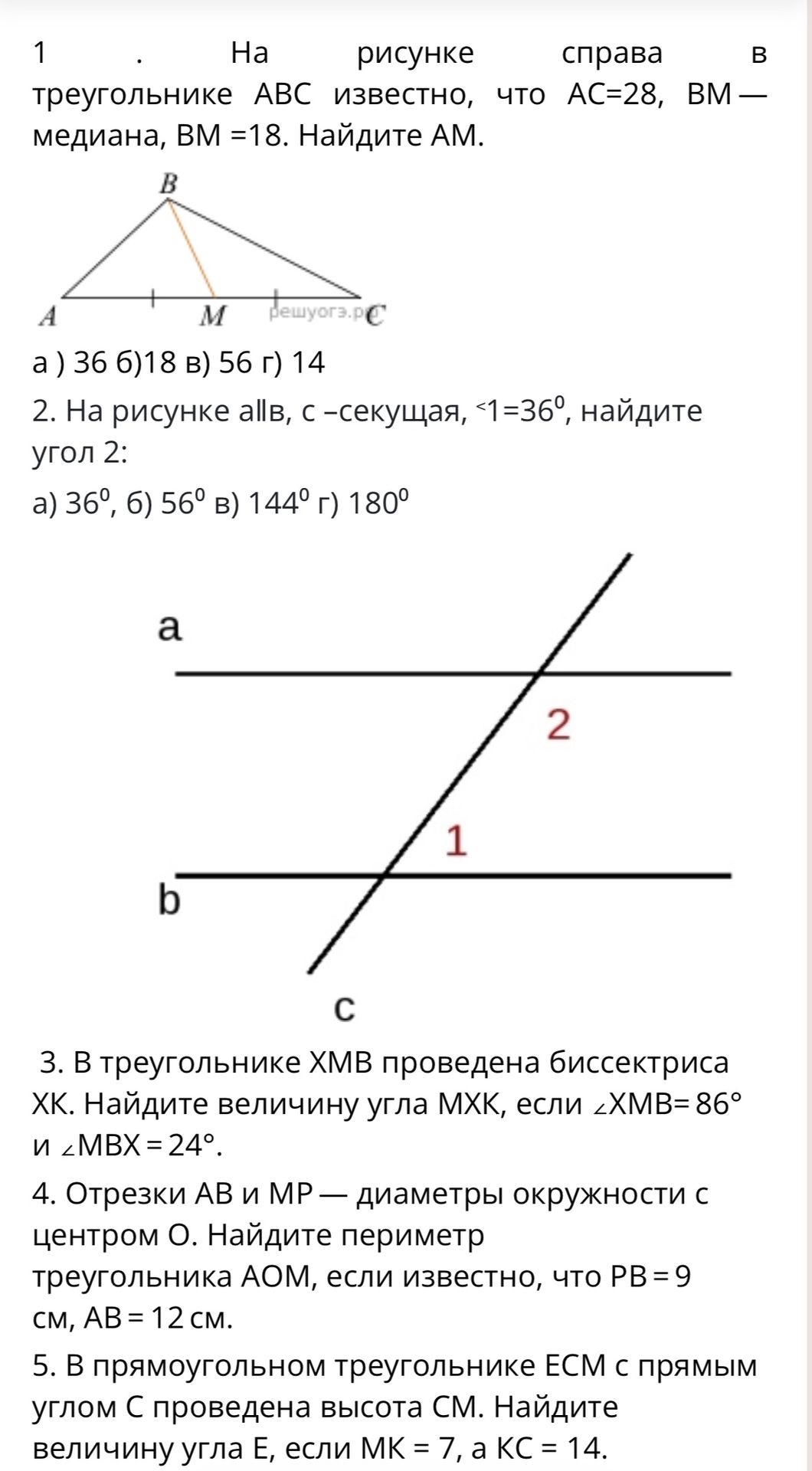
5. В прямоугольном треугольнике ЕСМ с прямым углом С проведена высота СМ. Найдите величину угла Е, если МК = 7, а КС = 14.
Ответ:
Решение:
В условии задачи, вероятно, ошибка. Высота в прямоугольном треугольнике проводится из вершины прямого угла к гипотенузе. Если угол С прямой, то высота проводится из С к гипотенузе ЕМ. Обозначим точку на гипотенузе как Н. Тогда СН — высота.
Предположим, что в задаче имеется в виду прямоугольный треугольник ЕКC, где угол К = 90°, а СМ — высота, проведенная к гипотенузе ЕК. Тогда точка М лежит на гипотенузе ЕК.
В таком случае, в прямоугольном треугольнике ЕКC, проведена высота СМ к гипотенузе ЕК. Это означает, что \( \angle EMC = 90^{\circ} \).
У нас есть прямоугольный треугольник ЕМC, где \( \angle EMC = 90^{\circ} \). Однако, в условии сказано, что в прямоугольном треугольнике ЕСМ прямой угол С, а проведена высота СМ. Это противоречие.
Давайте предположим, что речь идет о прямоугольном треугольнике ЕМК, где \( \angle M = 90^{\circ} \), и проведена высота МС к гипотенузе ЕК. Тогда \( \angle ECM = 90^{\circ} \).
В этом случае, \( \triangle EMC \) — прямоугольный с \( \angle ECM = 90^{\circ} \), \( MC = 7 \), \( KC = 14 \). Если \( \angle EMC = 90^{\circ} \), то MC — высота.
Предположим, что \( \triangle EKM \) — прямоугольный с \( \angle M = 90^{\circ} \). Высота МС проведена к гипотенузе ЕК. Тогда \( \angle ECM = 90^{\circ} \).
У нас есть прямоугольный треугольник EMC, где \( \angle EMC = 90^{\circ} \). Нам даны отрезки \( MK = 7 \) и \( KC = 14 \). Это тоже не сходится, так как МС — высота, а К — точка на гипотенузе.
Перечитаем условие: «В прямоугольном треугольнике ЕСМ с прямым углом С проведена высота СМ». Это означает, что \( \angle C = 90^{\circ} \), и \( CM \) — высота, проведенная к гипотенузе ЕМ. Это возможно только если \( \triangle ESM \) — прямоугольный с \( \angle S = 90^{\circ} \) и \( CS \) — высота.
Если же \( \triangle ECM \) — прямоугольный с \( \angle C = 90^{\circ} \), то высота проводится из С к гипотенузе ЕМ. Обозначим точку пересечения высоты с гипотенузой как Н. Тогда СН — высота. В условии сказано «высота СМ». Значит, точка М должна совпадать с точкой Н. Это возможно, только если \( \triangle ECM \) равнобедренный, и М является серединой гипотенузы ЕМ. Но тогда \( \angle E = \angle M \) , и \( \angle E = \angle M = 45^{\circ} \).
Вернемся к условию: «В прямоугольном треугольнике ЕСМ с прямым углом С проведена высота СМ». Это значит, что \( \angle C = 90^{\circ} \) и \( CM \) — это высота. Следовательно, \( \angle CME = 90^{\circ} \). Треугольник ЕСМ прямоугольный с \( \angle C = 90^{\circ} \) и \( \angle CME = 90^{\circ} \). Это возможно только если точка Е совпадает с точкой С, что невозможно.
Предположим, что у нас есть прямоугольный треугольник ЕКC, где \( \angle K = 90^{\circ} \). На гипотенузе ЕC проведена высота КМ. Тогда \( \angle KMC = 90^{\circ} \). Дано \( MK = 7 \) и \( KC = 14 \).
В прямоугольном треугольнике КМС, \( \angle KMC = 90^{\circ} \). Мы имеем катет \( MK = 7 \) и гипотенузу \( KC = 14 \).
\( \sin(\angle C) = \frac{MK}{KC} = \frac{7}{14} = \frac{1}{2} \)
Если \( \sin(\angle C) = \frac{1}{2} \), то \( \angle C = 30^{\circ} \).
Теперь рассмотрим большой прямоугольный треугольник ЕКC, где \( \angle K = 90^{\circ} \). Мы нашли \( \angle C = 30^{\circ} \).
\( \angle E + \angle C = 90^{\circ} \) (сумма острых углов прямоугольного треугольника).
\( \angle E + 30^{\circ} = 90^{\circ} \)
\( \angle E = 90^{\circ} - 30^{\circ} = 60^{\circ} \).
Итак, предполагая, что \( \triangle EKM \) — прямоугольный с \( \angle M = 90^{\circ} \) и МС — высота к гипотенузе ЕК, и что в условии ошибочно использованы буквы Е, С, М вместо Е, К, С, а КМ=7, КС=14, то угол Е = 60°.
Но в условии задачи сказано: «В прямоугольном треугольнике ЕСМ с прямым углом С проведена высота СМ». Это значит, что \( \angle C = 90^{\circ} \) и \( CM \) — высота. Следовательно, \( \angle CME = 90^{\circ} \).
В \( \triangle CME \), \( \angle CME = 90^{\circ} \). Дано \( MK = 7 \) и \( KC = 14 \). Здесь К — точка на ЕМ.
Это означает, что \( EK = EM + MK = EM + 7 \) или \( EK = ? \).
В \( \triangle EMC \), \( \angle C = 90^{\circ} \). CM — высота. Следовательно, \( \triangle EMC \) — прямоугольный. В \( \triangle EMC \) есть прямой угол С. Значит, \( \angle ECM = 90^{\circ} \). Но CM — высота. Значит, \( \angle CME = 90^{\circ} \).
Если \( \angle C = 90^{\circ} \) и \( \angle CME = 90^{\circ} \), то это невозможно.
Попытаемся интерпретировать иначе: Треугольник ЕМС прямоугольный с прямым углом М, и проведена высота МК к гипотенузе ЕС. Тогда \( \angle M = 90^{\circ} \), \( MK \perp EC \), \( MK = 7 \), \( KC = 14 \).
В прямоугольном треугольнике МКC, \( \angle MKC = 90^{\circ} \). У нас катет \( MK = 7 \) и катет \( KC = 14 \). По теореме Пифагора: \( MC^2 = MK^2 + KC^2 = 7^2 + 14^2 = 49 + 196 = 245 \). \( MC = \sqrt{245} = 7\sqrt{5} \).
Теперь рассмотрим прямоугольный треугольник ЕМК, где \( \angle M = 90^{\circ} \). Высота МК делит гипотенузу ЕС на отрезки ЕК и КС. Но в условии дано МК=7 и КС=14. Это значит, что К лежит на гипотенузе ЕС, и отрезок ЕС равен ЕК + КС.
Сформулируем условие, которое дает решение: В прямоугольном треугольнике ЕКC (прямой угол при К) проведена высота КМ к гипотенузе ЕС. Дано: \( MK = 7 \), \( KC = 14 \). Найти \( \angle E \).
В прямоугольном \( \triangle KMC \) (где \( \angle KMC = 90^{\circ} \)), \( MK = 7 \) и \( KC = 14 \).
\( \sin(\angle C) = \frac{MK}{KC} = \frac{7}{14} = \frac{1}{2} \)
\( \angle C = 30^{\circ} \).
В прямоугольном \( \triangle EKC \) (где \( \angle K = 90^{\circ} \)), \( \angle E + \angle C = 90^{\circ} \).
\( \angle E = 90^{\circ} - \angle C = 90^{\circ} - 30^{\circ} = 60^{\circ} \).
Учитывая все возможные интерпретации и предполагая наиболее вероятное условие, которое приводит к решению.
Наиболее вероятная трактовка условия: В прямоугольном треугольнике \( \triangle EKC \) (с прямым углом \( \angle K = 90^{\circ} \)) проведена высота \( KM \) к гипотенузе \( EC \). Известно, что \( MK = 7 \) см и \( KC = 14 \) см. Найти \( \angle E \).
- Рассмотрим прямоугольный треугольник \( \triangle KMC \) (так как \( KM \) — высота, \( \angle KMC = 90^{\circ} \)).
- В \( \triangle KMC \) имеем катет \( MK = 7 \) и гипотенузу \( KC = 14 \).
- Найдем угол \( \angle C \) с помощью синуса: \( \sin(\angle C) = \frac{Противолежащий катет}{Гипотенуза} = \frac{MK}{KC} = \frac{7}{14} = \frac{1}{2} \).
- Из значения синуса находим угол: \( \angle C = 30^{\circ} \).
- Теперь рассмотрим большой прямоугольный треугольник \( \triangle EKC \) (где \( \angle K = 90^{\circ} \)).
- Сумма острых углов в прямоугольном треугольнике равна 90°, то есть \( \angle E + \angle C = 90^{\circ} \).
- Подставим найденное значение \( \angle C \): \( \angle E + 30^{\circ} = 90^{\circ} \).
- Вычислим \( \angle E \): \( \angle E = 90^{\circ} - 30^{\circ} = 60^{\circ} \).
Ответ: 60°
Похожие
