
 Алгебра
 Английский
 Биология
 География
 Геометрия
 История
 Русский
 Обществознание
 Физика
 Химия
 Информатика
 Литература
 Математика
Ответ:
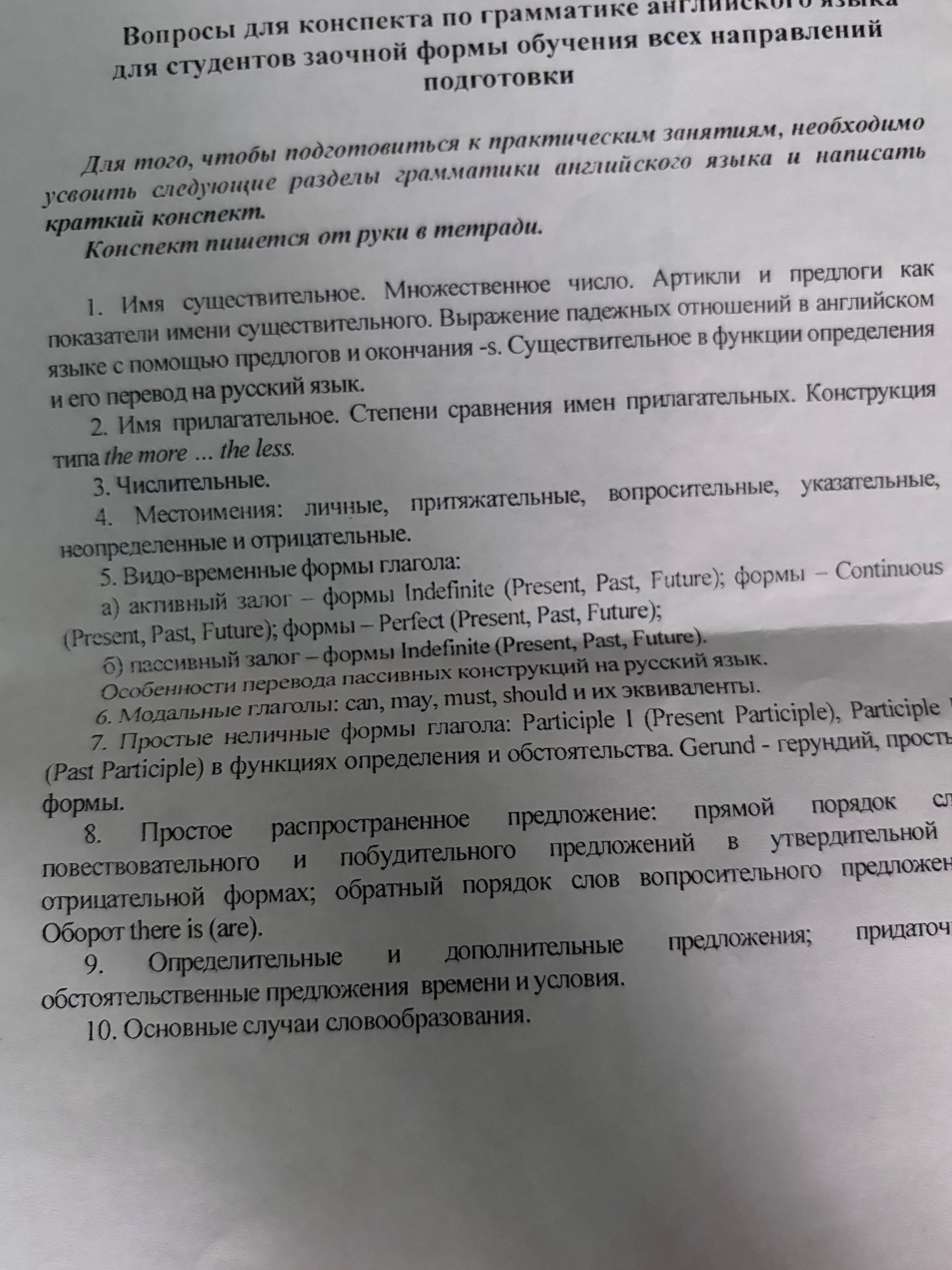
Перевод задания: Write a brief summary of the active forms Indefinite, Continuous and Perfect in the present, past and future, and the passive forms Indefinite in these three tenses. Explain how passive constructions are translated into Russian.
Active voice. Indefinite (Simple) describes facts, habits or completed actions: Present Simple V/V-s (She works), Past Simple V-ed or the second form (She worked), Future Simple will + V (She will work). Continuous describes an action in progress: am/is/are + V-ing, was/were + V-ing, will be + V-ing. Perfect connects an action with a particular time or result: have/has + V3, had + V3, will have + V3.
Passive voice. In the Indefinite forms, use the appropriate form of be + V3: Present is made, Past was made, Future will be made. The agent can be added with by: The book was written by Orwell. Russian translation depends on context: use a passive form (Книга была написана), a reflexive verb (Книга продаётся) or an active sentence with the object of the English sentence as the subject (The door was opened — «Дверь открыли»).
Перевод ответа: Активный залог. Indefinite (Simple) обозначает факты, привычки или завершённые действия: Present Simple — V/V-s (She works — она работает), Past Simple — V-ed или вторая форма глагола (She worked — она работала), Future Simple — will + V (She will work — она будет работать). Continuous обозначает действие в процессе: am/is/are + V-ing, was/were + V-ing, will be + V-ing. Perfect связывает действие с определённым моментом или результатом: have/has + V3, had + V3, will have + V3.
Пассивный залог. В Indefinite используются соответствующая форма глагола be + V3: Present — is made, Past — was made, Future — will be made. Действующее лицо можно добавить с помощью by: The book was written by Orwell. — Книга была написана Оруэллом. На русский пассивные конструкции переводятся с учётом контекста: пассивной формой (Книга была написана), возвратным глаголом (Книга продаётся) или активным предложением, где дополнение английского предложения становится подлежащим (The door was opened — «Дверь открыли»).
