
 Алгебра
 Английский
 Биология
 География
 Геометрия
 История
 Русский
 Обществознание
 Физика
 Химия
Химия Информатика
 Литература
 Математика
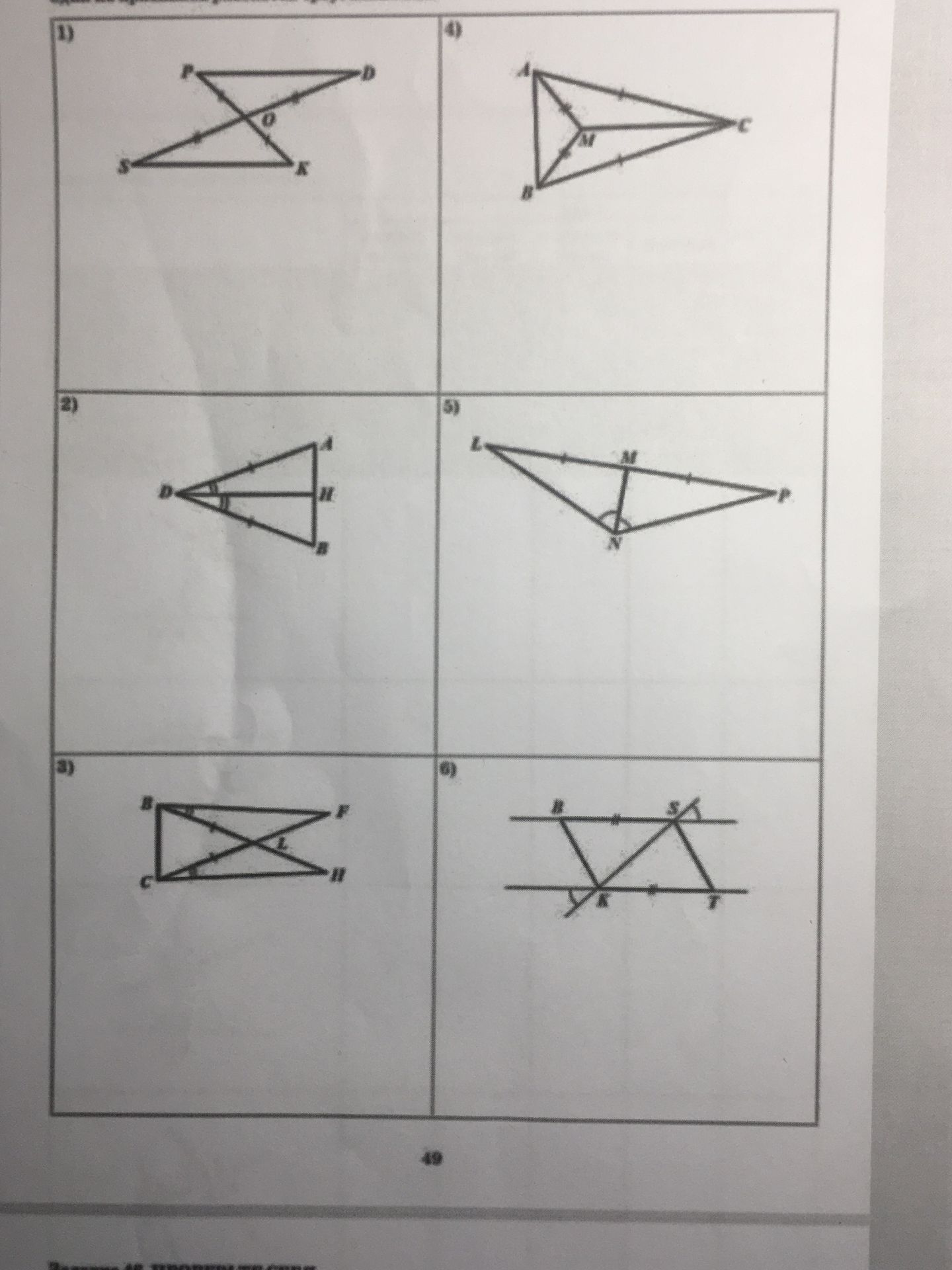
6) Analyze the figure with parallel lines and transversal segments.
Ответ:
6) Analysis:
The figure shows two parallel lines intersected by two transversals.
Let the top parallel line be denoted as L1 and the bottom parallel line as L2.
Points B and S are on L1. Points K and T are on L2.
Segments BS and KT are drawn such that they form two triangles, BSK and STK, and possibly other related figures.
The markings indicate:
- L1 is parallel to L2 (indicated by the arrows on the lines).
- Segment BK is parallel to segment ST (indicated by arrows on these segments). This forms a parallelogram BKTS.
- Segment BS is equal to segment KT (indicated by single tick marks).
- Segment SK is equal to segment BT (indicated by double tick marks).
Conclusions:
Given that L1 || L2 and BK || ST:
- The figure BKTS is a parallelogram because both pairs of opposite sides are parallel.
In a parallelogram, opposite sides are equal:
- BS = KT (This is consistent with the given markings).
- BK = ST (This is consistent with the given markings).
Since BS || KT and BK || ST, we can also conclude that triangles formed by the diagonals are congruent. For example, triangle BSK and triangle TKS would be congruent if the diagonals bisected each other, but we are not given information about the intersection of diagonals.
However, if we consider the transversal SK intersecting parallel lines L1 and L2, then angle BSK and angle SKT are alternate interior angles, so angle BSK = angle SKT. Similarly, for transversal BT, angle SBT and angle BTK are alternate interior angles, so angle SBT = angle BTK.
If BS = KT and BK || ST, then BKTS is a parallelogram.
If BK = ST and BS || KT, then BKTS is a parallelogram.
If BS = KT and BK = ST, then BKTS is a parallelogram.
The figure formed by points B, S, K, T is a parallelogram.
Conclusion: The figure BKTS is a parallelogram, where opposite sides are parallel and equal in length.
Похожие
- 1) Find the relationship between the segments.
- 2) Based on the markings, what can be concluded about triangle ADB and segment DH?
- 3) Identify the congruent triangles and the relationship between the segments.
- 4) Determine the relationship between the segments in triangle ABC with point M.
- 5) Based on the markings, identify the type of triangle LNP and the role of segment MN.
