
 Алгебра
 Английский
 Биология
 География
 Геометрия
 История
 Русский
 Обществознание
 Физика
 Химия
 Информатика
 Литература
 Математика
Ответ:
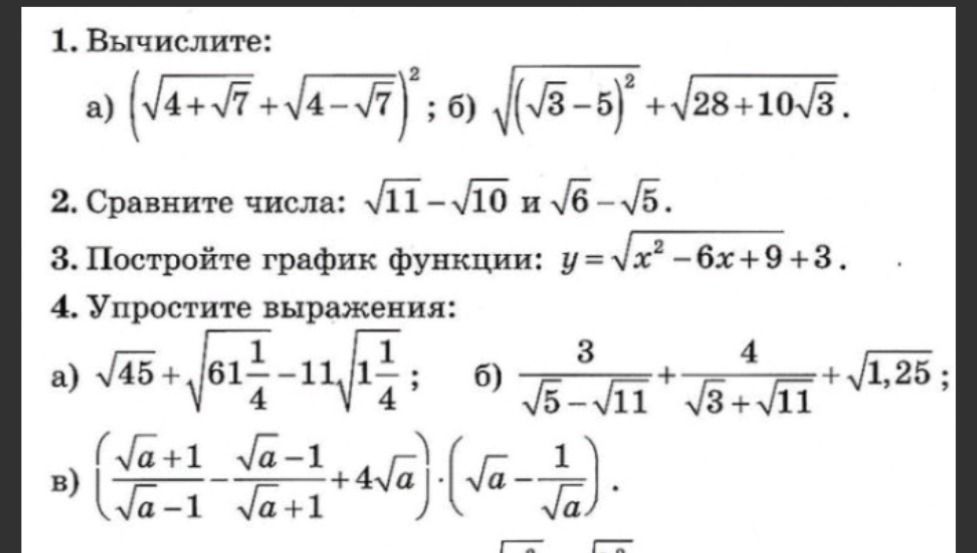
а) Преобразуем смешанные числа и извлечём корни:
\[\sqrt{45}+\sqrt{61\frac14}-11\sqrt{1\frac14}=3\sqrt5+\frac{\sqrt{245}}2-11\cdot\frac{\sqrt5}2=3\sqrt5+\frac{7\sqrt5}2-\frac{11\sqrt5}2=\sqrt5.\]
б) Рационализуем знаменатели и заметим, что \(\sqrt{1{,}25}=\frac{\sqrt5}{2}\):
\[\frac{3}{\sqrt5-\sqrt{11}}=-\frac{\sqrt5+\sqrt{11}}2,\qquad \frac{4}{\sqrt3+\sqrt{11}}=\frac{\sqrt{11}-\sqrt3}2.\]
\[ -\frac{\sqrt5+\sqrt{11}}2+\frac{\sqrt{11}-\sqrt3}2+\frac{\sqrt5}2=-\frac{\sqrt3}2.\]
в) Область допустимых значений: \(a>0\), \(a\ne1\). Обозначим \(t=\sqrt a\). Тогда
\[\frac{t+1}{t-1}-\frac{t-1}{t+1}+4t=\frac{(t+1)^2-(t-1)^2}{t^2-1}+4t=\frac{4t}{t^2-1}+4t=\frac{4t^3}{t^2-1}.\]
Также \(t-\frac1t=\frac{t^2-1}{t}\), поэтому произведение равно \(\frac{4t^3}{t^2-1}\cdot\frac{t^2-1}{t}=4t^2=4a\).
Ответ: а) \(\sqrt5\); б) \(-\frac{\sqrt3}{2}\); в) \(4a\), при \(a>0\), \(a\ne1\).
