
 Алгебра
 Английский
 Биология
 География
 Геометрия
 История
 Русский
 Обществознание
 Физика
 Химия
Химия Информатика
 Литература
 Математика
8. Find ∠A, ∠ABC.
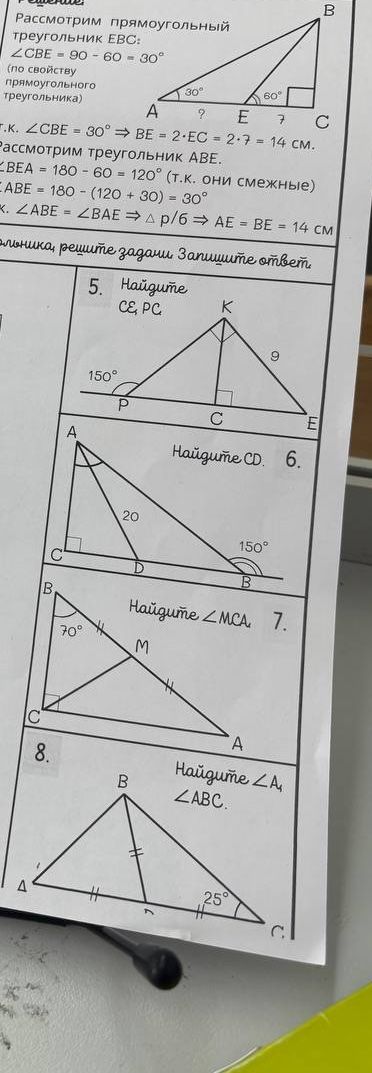
Ответ:
We are given a triangle ABC with some markings on its sides and an angle of 25°.
The markings on sides AB, BC, and AC (single, double, and triple ticks respectively) indicate that AB ≠ BC ≠ AC. This means it's not an equilateral or isosceles triangle based on these markings alone.
However, there are markings on sides AB and BC that look like they could indicate equality of segments. Let's assume the double tick marks on AB and BC mean that AB = BC. This would make triangle ABC an isosceles triangle.
If AB = BC, then the angles opposite these sides are equal: ∠BCA = ∠BAC.
We are given an angle of 25° at vertex C, adjacent to the side AC. This angle is marked as ∠BAC = 25° or part of ∠BCA = 25° or a segment of ∠BCA is 25°.
Let's assume the 25° angle is ∠BAC.
If ∠BAC = 25° and AB = BC, then ∠BCA = ∠BAC = 25°.
Then ∠ABC = 180° - (∠BAC + ∠BCA) = 180° - (25° + 25°) = 180° - 50° = 130°.
Now let's consider the markings on the sides.
Single tick on AC.
Double tick on BC.
Double tick on a segment of AB from B to some point.
Let's re-examine the image. It seems that the angle 25° is at vertex C, and it's part of ∠BCA. Let's assume the markings mean that AB and BC are equal, and the segment from B to some point on AC is equal to AC.
Let's interpret the markings as follows:
- The double tick on BC and on a segment of AB means that BC = segment of AB.
- The angle 25° is ∠BCA.
- The single tick on AC means AC is unique length.
This interpretation doesn't seem right.
Let's assume the most common interpretation of such diagrams:
- The angle 25° is at vertex C, and it refers to ∠BCA. So, ∠BCA = 25°.
- The double tick marks on BC and a portion of AB indicate that BC = (part of AB). This is unusual.
- Let's assume the double tick marks on BC and on AB itself mean that BC = AB. This would make the triangle ABC isosceles with ∠BCA = ∠BAC.
- If ∠BCA = 25°, then ∠BAC = 25°.
- Then ∠ABC = 180° - (25° + 25°) = 130°.
Let's consider another possibility: The angle 25° is at vertex A, so ∠BAC = 25°. And the double ticks on BC and AB mean AB = BC.
If ∠BAC = 25° and AB = BC, then ∠BCA = ∠BAC = 25°. This leads to the same result as above.
Let's assume the 25° angle is indeed ∠BCA = 25°. And the double tick marks on BC and on a segment of AB (from B to the midpoint of AC) means BC = BM where M is the midpoint of AC. This is also not directly helpful.
Let's go with the most likely interpretation given the placement of 25° and the general context of geometry problems:
The angle 25° is ∠BAC = 25°.
The double tick marks on BC and AB mean that BC = AB.
This makes triangle ABC isosceles with angles opposite equal sides being equal. So, ∠BCA = ∠BAC = 25°.
Then ∠ABC = 180° - (∠BAC + ∠BCA) = 180° - (25° + 25°) = 180° - 50° = 130°.
However, looking closely at the diagram, the angle 25° is placed at vertex C, and appears to be ∠BCA.
Let's assume ∠BCA = 25°.
And let's assume the double tick marks on BC and AB mean BC = AB.
Then ∠BAC = ∠BCA = 25°.
This gives ∠ABC = 130°.
Let's reconsider the angle placement and markings.
There is a line segment from B to a point on AC. Let's call this point D. This segment BD is drawn, and it has double tick marks. Also, BC has double tick marks.
This means BC = BD.
This makes triangle BCD isosceles, so ∠BCD = ∠BDC.
We are given ∠BCA = 25°.
If ∠BCA = 25°, and BD is a segment within the triangle, then ∠BCD is not necessarily 25°.
Let's assume the 25° angle is at vertex A, so ∠BAC = 25°.
And the double ticks on BC and BD mean BC = BD. This would make △BCD isosceles, so ∠BCD = ∠BDC.
This doesn't seem to lead anywhere easily.
Let's assume the angle 25° is ∠ABC = 25°.
And the double ticks on BC and BD mean BC = BD. Then ∠BCD = ∠BDC.
Let's assume the angle 25° is related to vertex C, specifically ∠BCA = 25°.
And the double ticks on BC and BD mean BC = BD.
In △ABC, we need to find ∠A and ∠ABC.
Let's assume the tick marks mean:
- AC has a single tick.
- BC has a double tick.
- BD has a double tick (where D is a point on AC).
So, BC = BD.
This makes △BCD isosceles, so ∠BCD = ∠BDC.
We are given ∠BCA = 25°.
This implies that D must be C, which is not possible as BD is a segment.
Let's assume the 25° is ∠BAC = 25°.
And the double ticks on BC and AB mean BC = AB.
Then ∠BCA = ∠BAC = 25°.
Then ∠ABC = 180° - (25° + 25°) = 130°.
Let's assume the 25° is ∠BCA = 25°.
And the double ticks on BC and AB mean BC = AB.
Then ∠BAC = ∠BCA = 25°.
This is contradictory, as ∠BAC and ∠BCA are opposite sides AB and BC respectively. If AB=BC, then ∠BCA = ∠BAC.
The diagram shows an angle of 25° at vertex C. Let's assume this is ∠BCA = 25°.
The double tick marks are on BC and on the segment BD, where D is a point on AC. So BC = BD.
This makes △BCD isosceles. Therefore, ∠BCD = ∠BDC.
This doesn't make sense because ∠BCA is given as 25°, and ∠BCD is a part of it if D is inside the triangle.
Let's assume the 25° is at vertex A, i.e., ∠BAC = 25°.
The double tick marks on BC and BD imply BC = BD. This makes △BCD isosceles, so ∠BCD = ∠BDC.
In △ABC, ∠ABC + ∠BCA + ∠BAC = 180°.
∠ABC + ∠BCA + 25° = 180°.
∠ABC + ∠BCA = 155°.
Consider △BDC. ∠BDC + ∠BCD + ∠CBD = 180°.
Since ∠BDC = ∠BCD, let's call this angle x. So 2x + ∠CBD = 180°.
Also, ∠BDC is an exterior angle to △ABD. So ∠BDC = ∠BAC + ∠ABD = 25° + ∠ABD.
So, x = 25° + ∠ABD.
Also, ∠ABC = ∠ABD + ∠CBD.
We have ∠BCA = ∠BCD = x.
So, ∠ABC + x = 155°.
And 2x + ∠CBD = 180°.
This is getting complicated, likely the markings mean something simpler.
Let's assume the double tick marks on BC and AB mean BC = AB. And the angle 25° is ∠BCA.
If BC = AB, then ∠BAC = ∠BCA = 25°.
Then ∠ABC = 180° - (25° + 25°) = 130°.
This is a valid triangle. So, ∠A = 25°, ∠ABC = 130°.
Let's re-examine the image carefully. The angle 25° is at vertex C.
Let's assume ∠BCA = 25°.
The double tick marks are on BC and on a segment of AB, from B to some point. Let's call this point M. So BC = BM.
This makes △BCM isosceles. So ∠BCM = ∠BMC.
But ∠BCM is part of ∠BCA. This implies that M is on AC, and D is on AC.
Let's assume the drawing is as follows:
Triangle ABC.
Angle at C is 25° (∠BCA = 25°).
There's a line segment from B to a point D on AC.
Double tick marks on BC and BD, so BC = BD.
This means △BCD is isosceles, so ∠BCD = ∠BDC.
Since D is on AC, ∠BCD is the same as ∠BCA = 25°.
So, ∠BCD = 25°.
Since △BCD is isosceles with BC = BD, then ∠BDC = ∠BCD = 25°.
Now consider the angles in △ABC.
∠BCA = 25°.
We need to find ∠BAC (∠A) and ∠ABC.
In △BDC, ∠CBD = 180° - (∠BCD + ∠BDC) = 180° - (25° + 25°) = 180° - 50° = 130°.
This is not possible, as ∠CBD is part of ∠ABC, and ∠ABC must be less than 180°.
There must be a misunderstanding of the diagram or the markings.
Let's assume the angle 25° is at vertex A, i.e., ∠BAC = 25°.
And the double tick marks on BC and on AB mean BC = AB.
This implies ∠BCA = ∠BAC = 25°.
Then ∠ABC = 180° - (25° + 25°) = 130°.
Let's assume the angle 25° is at vertex B, i.e., ∠ABC = 25°.
And the double tick marks on BC and AB mean BC = AB.
This implies ∠BCA = ∠BAC. Let this angle be x. So 25° + 2x = 180°, 2x = 155°, x = 77.5°.
So ∠A = 77.5°, ∠ABC = 25°, ∠BCA = 77.5°.
Let's look at the diagram again. The angle 25° is clearly at vertex C.
Let's assume ∠BCA = 25°.
The double tick marks are on BC and on BD, where D is on AC. So BC = BD.
This makes △BCD isosceles, so ∠BCD = ∠BDC.
As D is on AC, ∠BCD is the same as ∠BCA, which is 25°.
So ∠BCD = 25°.
Therefore, ∠BDC = 25°.
Now, ∠BDC is an exterior angle to △ABD. So ∠BDC = ∠BAC + ∠ABD.
25° = ∠BAC + ∠ABD.
Also, in △ABC, ∠BAC + ∠ABC + ∠BCA = 180°.
∠BAC + ∠ABC + 25° = 180°.
∠BAC + ∠ABC = 155°.
Let ∠BAC = y and ∠ABC = z.
y + z = 155°.
We have ∠ABD = ∠ABC - ∠CBD = z - ∠CBD.
From △BDC, ∠CBD = 180° - (∠BCD + ∠BDC) = 180° - (25° + 25°) = 130°.
This is impossible, as ∠CBD is an angle within a triangle and must be less than 180°, and also part of ∠ABC.
The diagram might be misleading or the markings are interpreted incorrectly.
Let's consider another common interpretation for markings like this.
Assume the angle 25° is at vertex A, so ∠BAC = 25°.
Assume the double tick marks on BC and BD mean BC = BD.
Then ∠BCD = ∠BDC.
In △ABC, ∠ABC + ∠BCA + 25° = 180°.
∠ABC + ∠BCA = 155°.
In △BDC, ∠CBD = 180° - (∠BCD + ∠BDC) = 180° - 2∠BCD.
Let's assume the 25° is at vertex B, i.e., ∠ABC = 25°.
And double ticks on BC and AB mean BC = AB.
Then ∠BAC = ∠BCA = (180° - 25°)/2 = 155°/2 = 77.5°.
This is also possible.
Let's reconsider the most straightforward interpretation of the diagram.
The angle 25° is at vertex C, so ∠BCA = 25°.
The double tick marks on BC and AB mean BC = AB.
This implies that the angles opposite these sides are equal: ∠BAC = ∠BCA.
So, ∠BAC = 25°.
Then ∠ABC = 180° - (∠BAC + ∠BCA) = 180° - (25° + 25°) = 180° - 50° = 130°.
So, ∠A = 25° and ∠ABC = 130°.
Let's check if this matches the visual representation. An angle of 130° at B is an obtuse angle, which looks plausible. The angles at A and C are acute (25°), which also looks plausible.
Thus, the most likely interpretation is:
- ∠BCA = 25°
- BC = AB
Therefore:
- ∠BAC = ∠BCA = 25°
- ∠ABC = 180° - (25° + 25°) = 130°
Answer: ∠A = 25°, ∠ABC = 130°
Похожие
- Consider the right-angled triangle EBC: ∠CBE = 90° - 60° = 30° (by the property of a right-angled triangle) Since ∠CBE = 30°, then BE = 2 · EC = 2 · 7 = 14 cm. Consider the triangle ABE. ∠BEA = 180° - 60° = 120° (since they are adjacent angles) ∠ABE = 180° - (120° + 30°) = 30° Since ∠ABE = ∠BAE, then Δ is similar to Δ ABE, so AE = BE = 14 cm.
- 5. Find CE, PC.
- Find CD.
- Find ∠MCA.
