
 Алгебра
 Английский
 Биология
 География
 Геометрия
 История
 Русский
 Обществознание
 Физика
 Химия
Химия Информатика
 Литература
 Математика
Вопрос:
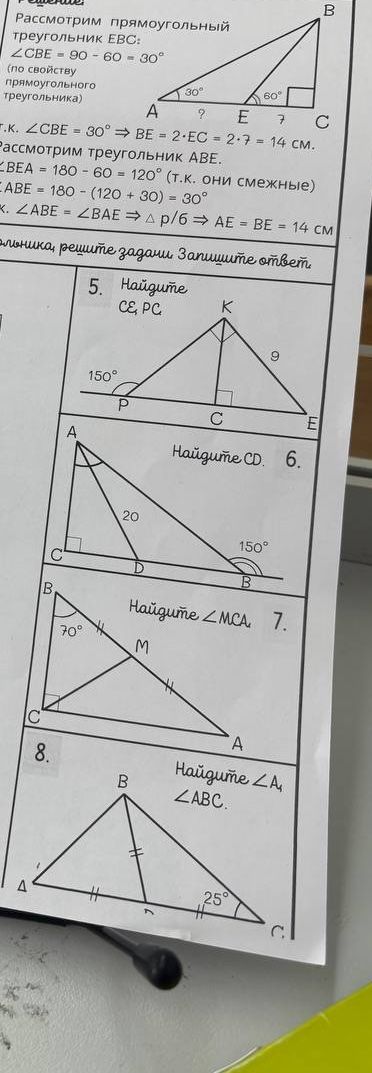
Consider the right-angled triangle EBC: ∠CBE = 90° - 60° = 30° (by the property of a right-angled triangle) Since ∠CBE = 30°, then BE = 2 · EC = 2 · 7 = 14 cm. Consider the triangle ABE. ∠BEA = 180° - 60° = 120° (since they are adjacent angles) ∠ABE = 180° - (120° + 30°) = 30° Since ∠ABE = ∠BAE, then Δ is similar to Δ ABE, so AE = BE = 14 cm.
Ответ:
This is a step-by-step solution to a geometry problem involving triangles.
- Given right-angled triangle EBC:
- We are given that ∠BCE = 90° and ∠BEC = 60°.
- Using the property of a right-angled triangle, ∠CBE = 90° - 60° = 30°.
- Since ∠CBE = 30°, and in a right-angled triangle the hypotenuse is twice the length of the leg opposite the 30° angle, we have BE = 2 · EC.
- Given EC = 7 cm, then BE = 2 · 7 = 14 cm.
- Consider triangle ABE:
- We are given that ∠BAC = 60° and ∠ABE = 30°.
- ∠BEA and ∠BEC are adjacent angles, so ∠BEA + ∠BEC = 180°.
- Therefore, ∠BEA = 180° - ∠BEC = 180° - 60° = 120°.
- The sum of angles in triangle ABE is 180°. So, ∠BAE + ∠ABE + ∠BEA = 180°.
- ∠BAE + 30° + 120° = 180°.
- ∠BAE = 180° - 150° = 30°.
- Since ∠ABE = ∠BAE = 30°, triangle ABE is an isosceles triangle with AE = BE.
- Therefore, AE = 14 cm.
The provided text seems to be a partial solution or explanation of a geometry problem. It demonstrates the steps to find lengths and angles in triangles using trigonometric properties and angle sum theorems.
Answer: The problem demonstrates the application of trigonometric properties and angle sum theorems in triangles.
Похожие
