
 Алгебра
 Английский
 Биология
 География
 Геометрия
 История
 Русский
 Обществознание
 Физика
 Химия
Химия Информатика
 Литература
 Математика
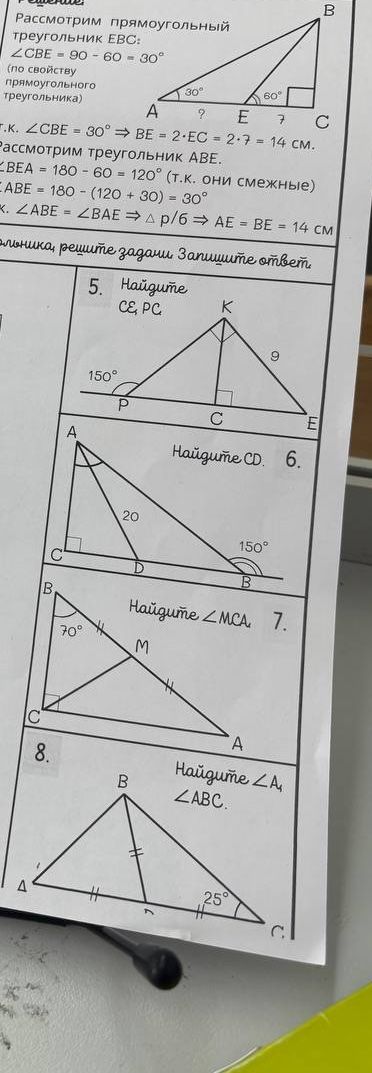
Find ∠MCA.
Ответ:
We are given a right-angled triangle ABC, with ∠BCA = 90°. We are given ∠CBM = 70°. M is a point on AB such that CM is drawn.
To find ∠MCA, we need to know the position of point M or the length of CM, or angles related to M.
If we assume that CM bisects ∠BCA, then ∠ACM = ∠BCM = 45°. However, there is no indication of this.
If we assume that CM is an altitude, then ∠CMA = 90°.
If we assume that CM is a median, then AM = MB.
The markings on sides BC and AM, and on sides AC and MB suggest some relationships:
- The double tick marks on BC and AM might indicate BC = AM.
- The single tick marks on AC and MB might indicate AC = MB.
Let's assume these equalities hold:
BC = AM
AC = MB
In right-angled triangle ABC, AB = AM + MB = BC + AC.
By Pythagorean theorem, AB² = AC² + BC².
So, (BC + AC)² = AC² + BC².
BC² + 2 · BC · AC + AC² = AC² + BC².
2 · BC · AC = 0.
This implies either BC = 0 or AC = 0, which is not possible for a triangle.
Therefore, the tick marks do not indicate equality of these specific segments.
Let's reconsider the markings.
If the markings on sides indicate equal lengths:
- Double ticks on BC and AM: BC = AM
- Single ticks on AC and MB: AC = MB
This leads to a contradiction as shown above.
Let's assume the markings indicate that certain segments are equal to each other within the figure.
Possibility 1: The double ticks on BC and AM mean BC = AM. The single ticks on AC and MB mean AC = MB.
Possibility 2: The double ticks mean BC = AM. The single ticks mean AC = MB.
Possibility 3: The double ticks mean BC = AC. The single ticks mean AM = MB. (This would mean CM is a median and also an altitude, hence triangle ABC is isosceles with AB=BC, which is not possible in a right triangle where hypotenuse is longest).
Let's assume the markings are meant to imply that CM is the median to the hypotenuse. In this case, CM = AM = MB. This would mean the single tick marks on AC and MB are irrelevant, and the double tick marks on BC and AM are also irrelevant.
If CM is the median to the hypotenuse AB, then AM = MB = CM. This means triangle AMC and triangle BMC are isosceles.
In triangle ABC, ∠CBA = 70°. Then ∠CAB = 180° - 90° - 70° = 20°.
In isosceles triangle AMC, ∠MAC = ∠MCA = 20°.
In isosceles triangle BMC, ∠MCB = ∠MBC = 70°.
Let's check if ∠ACM + ∠BCM = ∠ACB:
20° + 70° = 90°.
This is consistent with ∠ACB = 90°.
Therefore, based on the assumption that CM is the median to the hypotenuse (implied by the markings possibly indicating AM=MB=CM, though not explicitly stated), then ∠MCA = 20°.
Answer: 20°
Похожие
- Consider the right-angled triangle EBC: ∠CBE = 90° - 60° = 30° (by the property of a right-angled triangle) Since ∠CBE = 30°, then BE = 2 · EC = 2 · 7 = 14 cm. Consider the triangle ABE. ∠BEA = 180° - 60° = 120° (since they are adjacent angles) ∠ABE = 180° - (120° + 30°) = 30° Since ∠ABE = ∠BAE, then Δ is similar to Δ ABE, so AE = BE = 14 cm.
- 5. Find CE, PC.
- Find CD.
- 8. Find ∠A, ∠ABC.
