
 Алгебра
 Английский
 Биология
 География
 Геометрия
 История
 Русский
 Обществознание
 Физика
 Химия
Химия Информатика
 Литература
 Математика
Вопрос:
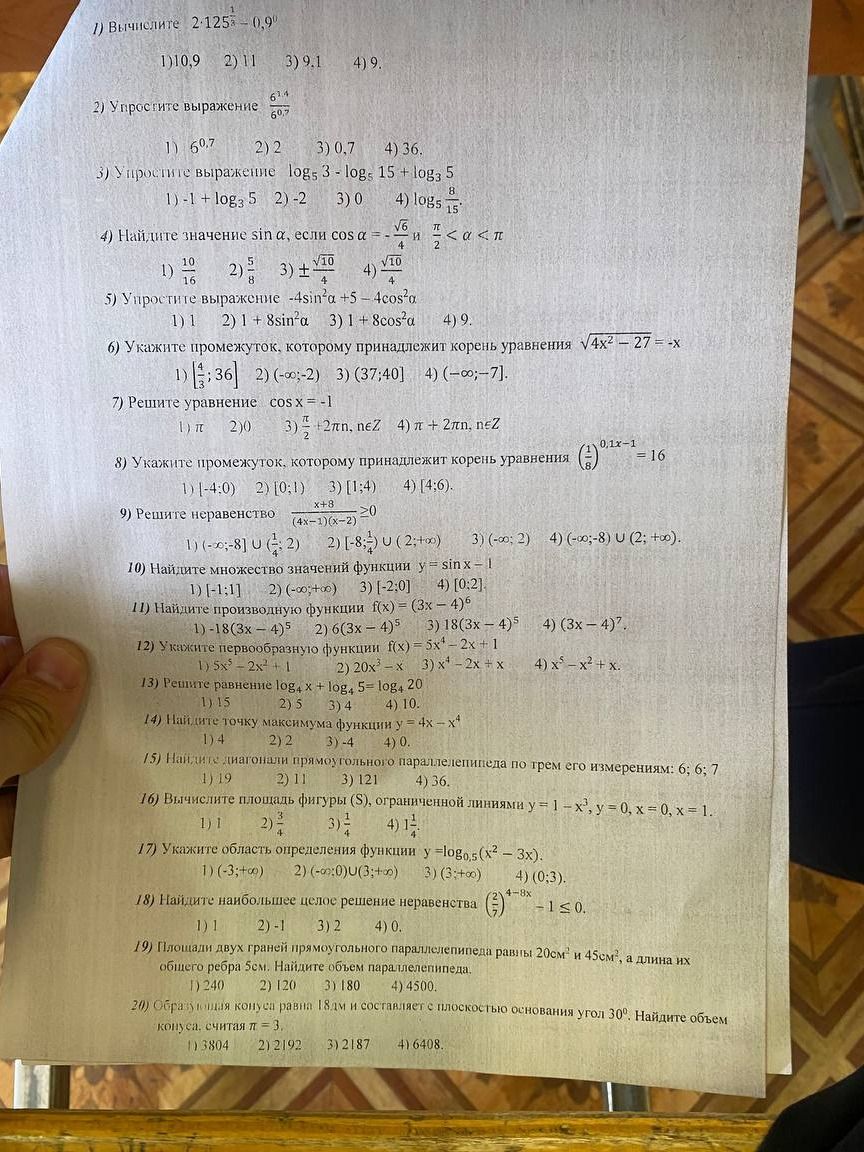
4) Найдите значение sin α, если cos α = -\(\frac{\sqrt{6}}{4}\) и \(\frac{\pi}{2} < \alpha < \pi\)
Ответ:
Решение:
Воспользуемся основным тригонометрическим тождеством: \( \sin^2 \alpha + \cos^2 \alpha = 1 \).
- Подставим известное значение \( \cos \alpha \):
\( \sin^2 \alpha + \frac{6}{16} = 1 \)
\( \sin^2 \alpha + \frac{3}{8} = 1 \)
\( \sin^2 \alpha = 1 - \frac{3}{8} \)
\( \sin^2 \alpha = \frac{5}{8} \)
- Теперь найдём \( \sin \alpha \):
- Учитывая условие \( \frac{\pi}{2} < \alpha < \pi \), угол \( \alpha \) находится во второй четверти. Во второй четверти синус положителен.
Ответ: \( \frac{\sqrt{10}}{4} \)
Похожие
- 1) Вычислите 2-125-0,9
- 3) Упростите выражение \( \log_5 3 - \log_5 15 + \log_5 5 \)
- 18) Найдите наибольшее целое решение неравенства \( \left(\frac{2}{7}\right)^{4-8x} - 1 \le 0 \)
- 20) Образующая конуса равна 18 дм и составляет с плоскостью основания угол 30°. Найдите объем конуса, считая \( \pi = 3 \).
